Beyond Automation: Rethinking Leverage, Leadership, and the Human Edge: Office Hours w/ Arvind KC
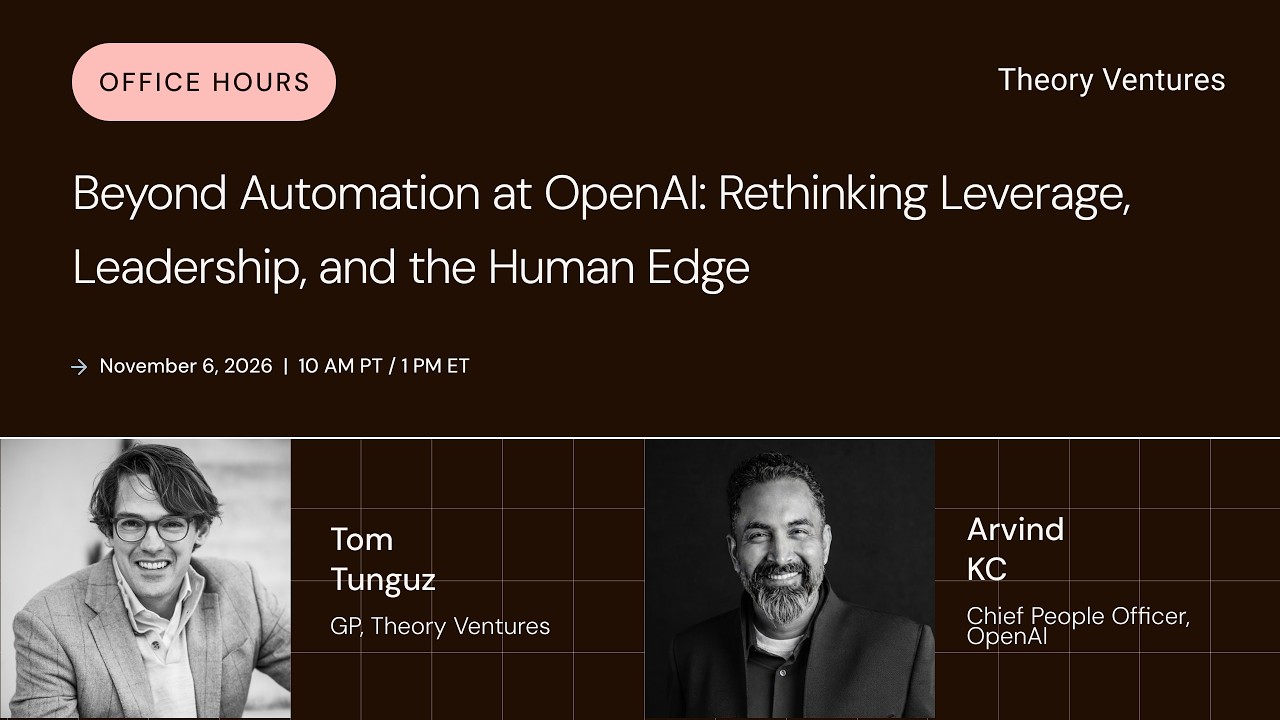
What should a company aim AI at when models can outperform its best people on its hardest problems? Arvind KC, Chief People Officer at OpenAI, joins Theory’s Founder & GP Tomasz Tunguz on Office Hours to discuss what happens to the people function in the AI era. Drawing on his experience as CIO at Palantir, VP of Engineering at Google, and Chief People and Systems Officer at Roblox, KC explains why efficiency is too small a goal, how teams of humans and virtual coworkers change the shape of an organization, and why EQ becomes the differentiator when everyone has access to the same intelligence.
In our conversation, we discuss:
- Why “junior” and “senior” lose meaning when everyone is new to working with AI
- Why efficiency changes earnings, while new capabilities change the price-to-earnings ratio
- What it means for every role to gain an “agent manager” dimension
- How models, harnesses, personal assistants, and specialist agents fit together
- Why humans acting as the middleware for company systems holds organizations back
- How a people team can start by reimagining a single workflow, such as onboarding
- Why EQ differentiates leaders as access to intelligence is democratized
Three takeaways from this conversation:
1. Point intelligence at the problems that define the company. KC traces how quickly models moved from failing simple puzzles two years ago to competition-level mathematics and open research problems. Applied to a call center, that intelligence makes an existing process cheaper. Applied to the core problems of an enterprise, such as chip design or semiconductor yield, it can change what the company is able to do. In KC’s framing, efficiency improves earnings, but new capabilities change how the market values the company: its price-to-earnings ratio. That second game is much larger.
2. Redesign work around outcomes, with humans and agents on the same team. The people team’s charter stays the same: build the workforce the organization needs. What changes is that the workforce now includes virtual coworkers. In the interim, KC expects every role to gain a suffix: a salesperson becomes a sales agent manager, and a recruiter becomes a recruiting agent manager. Scope and compensation will follow the ability to coordinate a few humans and many virtual coworkers toward an outcome. Traditional organizations use people as the middleware for their systems, doing work and then recording it in ERP, CRM, and HCM tools. When agents take on that “work on work,” people spend more time with each other, and the firm can organize around outcomes such as landing a customer or hiring a person. Two companies that look alike today, one handing out AI tools and one rethinking how work is done, are already on different slopes.
3. Start with one workflow, and lead with EQ. KC’s advice for people leaders is to convince themselves before they convince anyone else: use the tools extensively, then rebuild a workflow the people team controls. Onboarding is a good candidate. Treat it as a single mission instead of a handoff between people, workplace, IT, and security teams, and staff it with the right mix of humans and agents. Over time, he argues, the people team should own how work gets done and help leaders reimagine their functions. Because experience with AI loses value quickly, he would retire the labels “junior” and “senior” and look for curiosity, intensity, comfort with ambiguity, and humility instead. And when everyone can access the same intelligence, the differentiator becomes how people show up: their integrity, their empathy, and the care they bring to each interaction.
