Can a Team of AI Agents Defend Against Vulnerabilities in Your App?
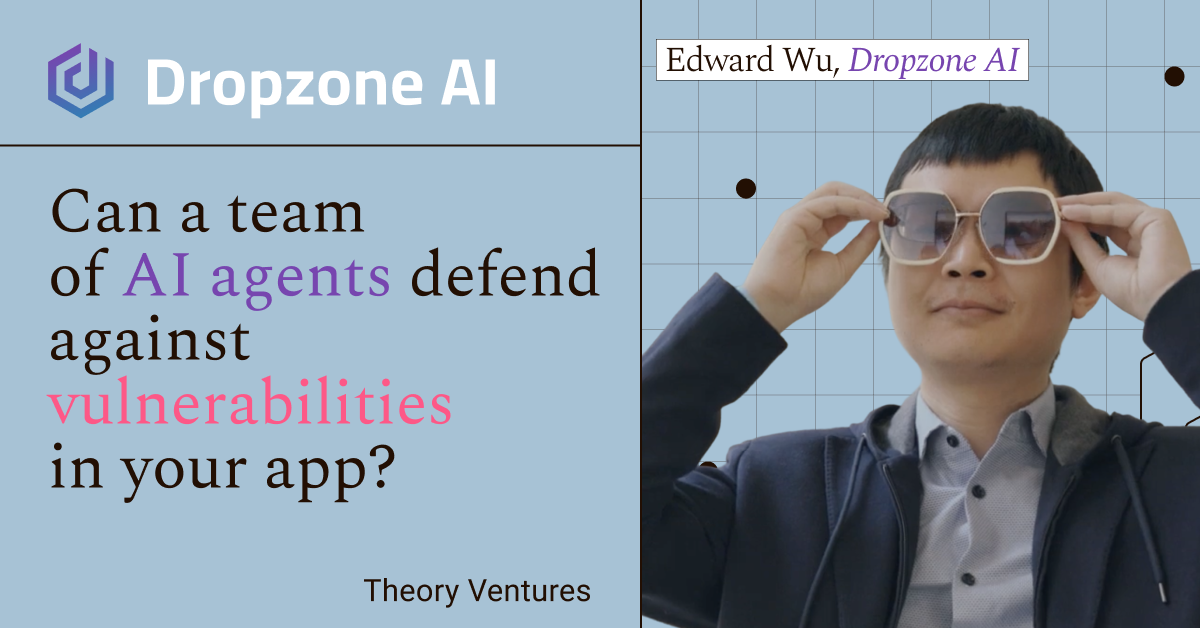
Attackers only need one clean shot; defenders need to win every bout. Edward Wu, founder and CEO of Dropzone AI, is building on the disadvantage side of that asymmetry: autonomous AI SOC analysts for cybersecurity teams at large organizations, government agencies, and enterprises. Because Dropzone is already putting agents to work on specialized security investigations, Edward has a concrete view of the frontier: moving SOC work from alert queues and prompts to agents that traverse logs, tools, hypotheses, and company context, then produce a recommendation and investigation report.
In our conversation, we discuss:
- How script kiddies turned LLMs into coding accomplices, writing attack code they couldn't write themselves.
- Why OpenAI, Anthropic, and DeepMind started gating cybersecurity access after models got stronger at finding vulnerabilities
- How a 30 to 60 minute alert investigation turns into a recursive agent loop
- How agents learn business context from policies, preferences, practices, Slack, and tickets
- Why one investigation can fan out into roughly a hundred LLM calls — parsing JSON, hitting REST and SQL, and planning next steps
- How model choice becomes a latency, writing-style, and trajectory-planning problem
- How to secure autonomous agents when useful access creates misuse and leakage risk
Three takeaways from this conversation:
1. Alert investigations are agent-shaped. A single alert can take 30 to 60 minutes of tool pivots, hypothesis generation, metadata gathering, and evidence refinement. Dropzone turns that recursive reasoning loop into an autonomous investigation path.
2. Context engineering is like archaeology. Dropzone extracts nuggets of organizational context from messy records, stores them in a database, then deconflicts contradictions between Slack threads and tickets before flagging ambiguous pieces for human operator review.
3. Agents handle the first 90 to 95% of threat investigation work, autonomously dismissing false positives while analysts focus on the smaller malicious or suspicious set. SOC automation becomes a judgment problem as much as a workflow problem.