The ERP That Makes Your Ops Data Useful
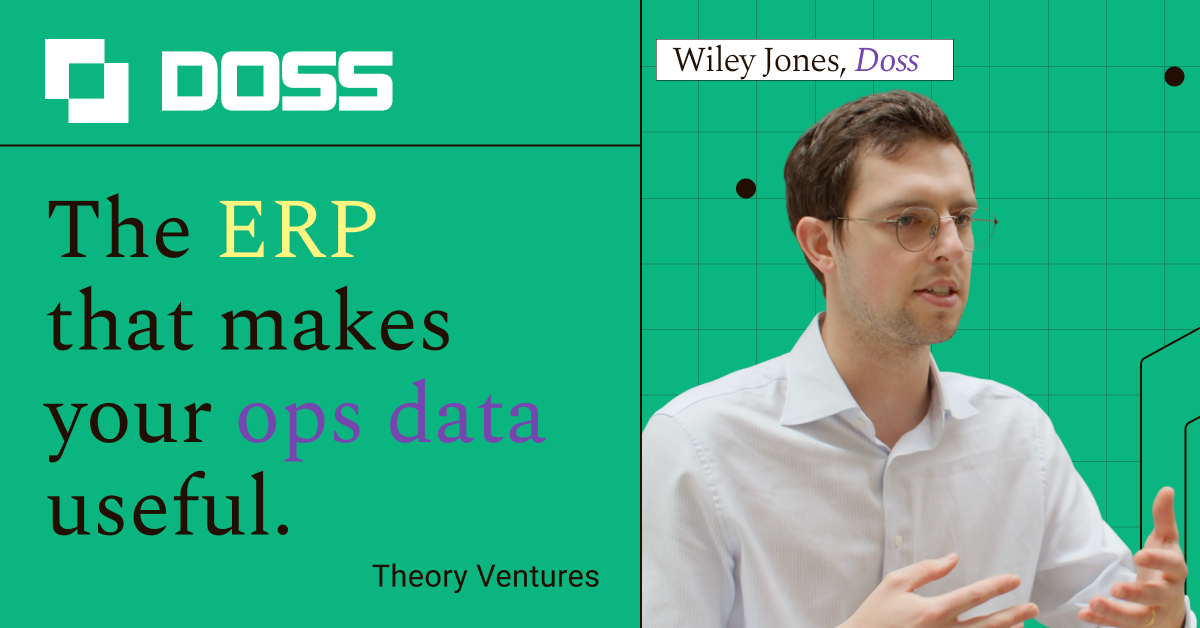
Ops teams don't fail because they lack dashboards—they fail because procurement, inventory, and channel P&L never resolve to the same numbers. Wiley, co-founder and CEO of Doss, is rebuilding the category NetSuite has defined for two decades: a composable back office with a first-class data layer inside it, plus a TypeScript DSL that language models already write. Bryan and Wiley get into where LLMs actually speed implementation, why agents need jackhammers not spoons, and which operators are ready to replace the incumbent stack.
In our conversation, we discuss:
- Why ERP wants a Snowflake-style data layer
- Why Doss needs a DSL and why it's TypeScript
- Where LLMs compress migrations, mappings, and integrations before go-live
- Why Doss owns implementation instead of handing customers a new job
- In the alpha zone: jackhammers, spoons, and tool ergonomics for agents
- Why async agents matter more than a smarter chat window
- The pain and dimensionality test for knowing when a company is ready for Doss
Three takeaways from this conversation:
1. The warehouse belongs closer to the transaction. Doss’s bet is that products, SKUs, vendors, customers, and inventory flows should share the same master data from the start. That is what lets operators trace procurement through channel P&L without stitching together five “sources of truth.”
2. The dev loop is the product. Wiley is a TypeScript maxi because a typed DSL gives both humans and models something solid to write against. LLMs can compress migrations, mappings, and integrations before go-live—but Doss still owns implementation so customers do not inherit another platform job.
3. Agents need jackhammers, not spoons. Wiley has a hypothesis that the real surface area is async execution: scoped jobs that fan out, respect access and tenancy, and turn recurring ops work into computable units. Chat is useful, but it is not the revolution.