Theories
Stay up-to-date on our team's latest theses and research
Stay up-to-date on our team's latest theses and research
Developer Relations (“DevRel”) is most often associated with companies that build for developers, but what does it look like in venture capital?
In traditional DevRel, the function is straightforward: advocacy ensures developers not only adopt a product, but also use it well. The DevRel sits at the intersection of community, technical credibility, and storytelling, helping translate between builders and the broader ecosystem.
For Theory, a DevRel takes a different shape.
We’ve been a technical firm since day one, and have since engineered numerous AI workflows to improve how we operate as a team. With this, we have seen both failures and successes, and we believe in sharing those experiences with other builders.
By building DevRel into how we operate, we are expanding our efforts to extend and engage with communities that help technical founders succeed.
Founders don’t just evaluate capital. They evaluate investors for their value creation: are these people serious technologists who can give credible advice? Do they understand the tools and communities that matter today, not just the boardroom abstractions? Traditional marketing cannot answer that question. A DevRel can.
The role is a hybrid of technologist, writer, strategist, and investor.
By participating in the technical conversations & forums as users, we collapse the distance between our firm and the developers who strive to build at the cutting edge. The result is better dialogue, sharper insight, and an ecosystem that sees us as genuine collaborators rather than distant financiers.
The obvious function of DevRel is outward-facing: exploring & amplifying ideas, highlighting tech we find impressive, and engaging on topics that matter. A strong outward presence ensures the firm is visible not just when capital is exchanged, but long before—at meetups, in online forums, and in the debates that shape new technologies.
Less obvious, but equally important, is the inward function. A DevRel is also a sensor: detecting signals from technical communities, surfacing emerging trends, and translating the chatter of early adopters into actionable insight. In this way, DevRel doesn’t just broadcast a message; they tune the dial on our collective understanding of where technology is headed.
To our knowledge, no venture capital firm has yet invested in a full-fledged DevRel role. For us, the motivation is clear: by showing up and contributing in the open, we build relationships with the people pushing technology forward—the very people we hope to back and collaborate with in the future.
It’s a natural extension of our research-driven approach to identifying technical discontinuities, and it reflects what we value most: intellectual honesty, technical depth, and staying close to builders. We’ll see you in the arena.
When launching Theory in 2023 along with the associated website and brand, simplicity was paramount. Why bother over-baking a website before our portfolio or team really took shape? However, two and a half years later, we found ourselves in a different situation: hundreds of theses on the market crafted from deep research and experience, a world class team, and a portfolio to be proud of. It was time for a visual refresh, and it was a moment to explain how Theory works.
Theory differentiates via our depth. We continually map the universe of companies and how they interact in the market, leading to investment theses and ultimately investments in a small cohort of exceptional opportunities. These were what we set out to communicate via our new website.
To give you the full story, we recorded a video talking through some of the considerations.
The key artifacts of our investors’ work are theses – written explanations of how the world works, what companies (nascent or established) will be relevant, and what it will take for those to be important pillars of the future.
Internally, we have systems for building, remixing, and cross-referencing theses, but we thought the website would be an opportunity to give outsiders a telescope to peer into this data. We call the set of the companies, and their relationships, the universe of data. While there are many ways to visualize a highly-connected, unstructured, large-cardinality text dataset, we went with a 3D latent-space visualization of the companies, with an edge-graph defined by a sample of thesis cooccurrence. In other words: the companies Theory has looked at, grouped spatially, with connections based on our investment theories.
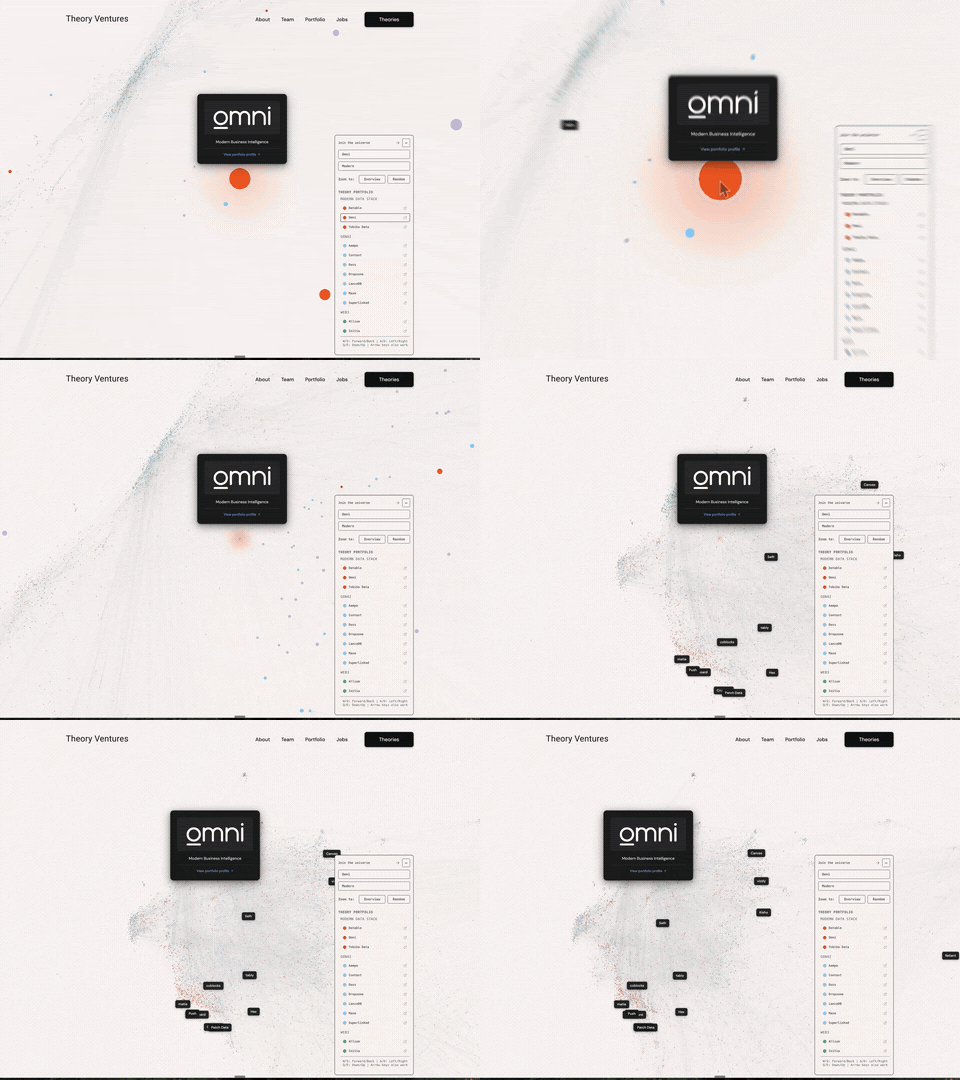
The other constraint was a design and presentation that paid respect to the data and the methods we embrace at Theory. Additionally, we’re aware of the environment where much web traffic is driven by AI agents; we’ve kept LLMs top of mind in this site’s execution.
To those ends, we worked with an incredible designer Richelle Rolli to help find our balance. With a love of paper & Edward Tufte, we prioritized showing, not telling via our universe of theses, married with the predictable sections of a VC website (team, portfolio, jobs, etc.) structured for absorption by a stylistically indifferent visitor.
Our hope is that we’ve delivered on our objectives with clarity and playfulness. We hope you enjoy the universe of theories and the new website.
If you’re a founder who doesn’t find yourself in our universe, we hope you’ll let us know.
.png)